Rethinking World History From a Small Island
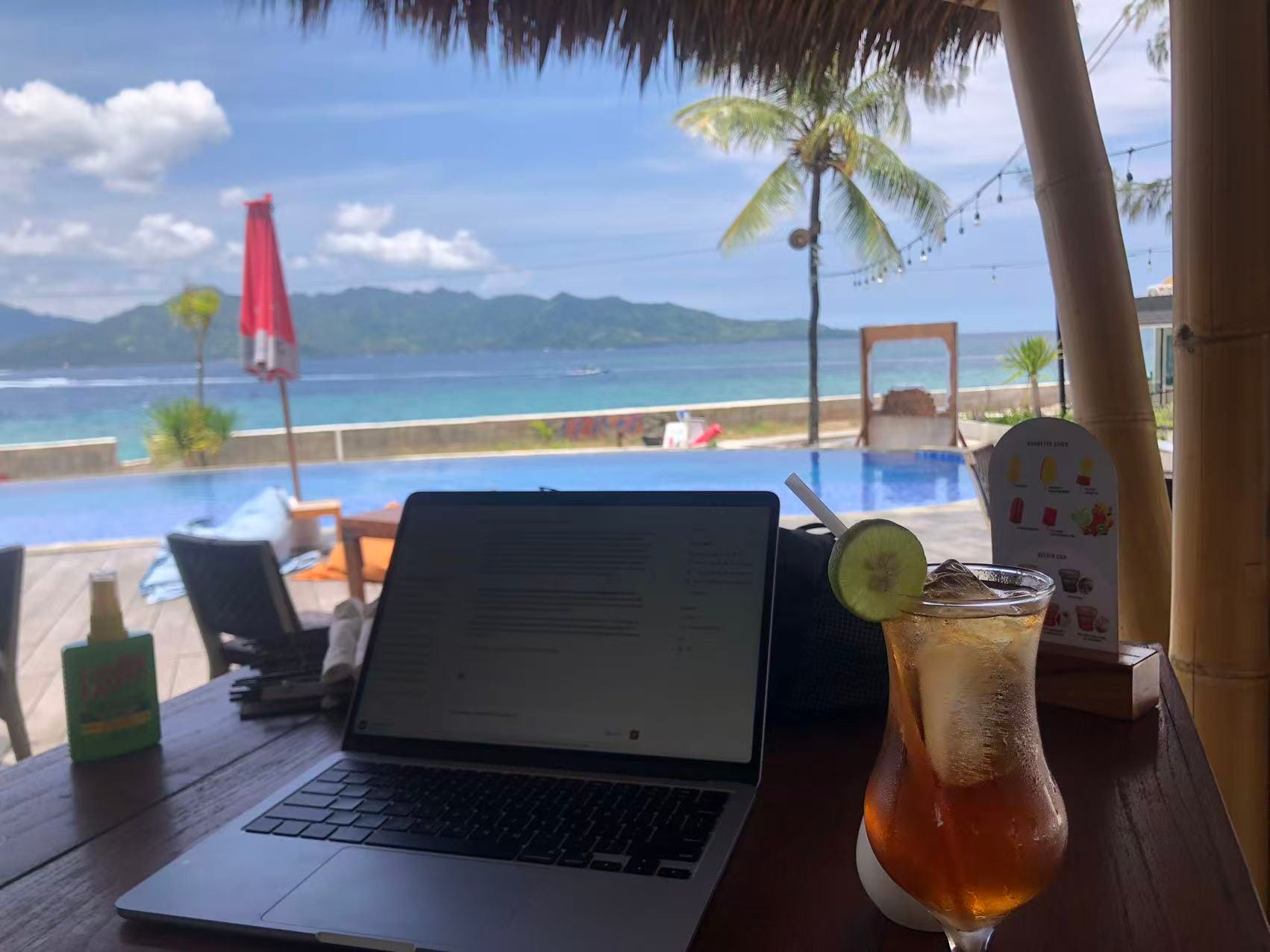
I'm sitting on Gili Air right now, iced tea in hand, watching the afternoon light stretch across the water toward Lombok. There are no cars on this island—just bicycles, horse carts, and people from every corner of the world wandering along sandy paths in flip-flops. A French couple is arguing gently about where to eat. A group of Indonesian kids are chasing each other near the dock. Somewhere behind me, a dive shop is blasting reggae.
It's the kind of place that makes you think about nothing and everything at the same time.
I've been scrolling through my WeChat groups between dips in the ocean, and lately the conversations have drifted—as they often do among my friends—toward big-picture questions. Not about tech this time, but about history. Specifically: why does the standard story of world history feel so off? Why does the version we all learned in school—where Greece, Rome, China, India, and the Islamic world are presented as parallel civilizations running their own independent programs—feel like it's missing something fundamental?
I've been thinking about this for a while, and I want to lay out a framework that I think explains a lot. It's not finished. It's not meant to be the final word. But sitting here on a tiny island in the middle of the Indonesian archipelago—itself a place shaped by the collision of Chinese trade networks, Indian religious influence, and European colonial ambition—it feels like the right moment to put it into words.
The Core Idea: Not All Civilizations Were Playing the Same Game
Here's the thought that started everything for me.
We're taught that world history is a story of multiple civilizations developing in parallel—each with its own genius, its own trajectory, its own internal logic—and that at some point around the 1500s, Europe pulled ahead through some combination of geography, institutions, and luck.
But what if that framing is fundamentally wrong? What if, for most of recorded history, there was really only one civilization operating at the highest level—one system that simultaneously maintained large-scale production, continuous technological accumulation, administrative coherence across centuries, and intergenerational knowledge transmission at a scale no one else came close to?
That civilization was China.
I know how that sounds. Bear with me. This isn't about nationalism or chauvinism. It's about looking at civilizational capability the way you'd look at a company's operational capacity—not by its branding or its narrative, but by what it actually does, at what scale, and for how long.
When you measure by those criteria—population under unified administration, continuity of technical innovation, depth of bureaucratic knowledge systems, longevity of institutional frameworks—China wasn't one civilization among equals. It was the civilizational matrix. The core operating system of the Eurasian continent. Everything else was, in different ways, orbiting it.
Three Systems, Not Three Equals
The way I've come to think about it, there were three major civilizational systems in Eurasian history, but they weren't peers. They operated at fundamentally different levels.
China was the matrix. The generator. The system that produced technology, accumulated knowledge, built institutions, and maintained all of it across millennia without interruption. Not just farming—that label has done so much damage to how people think about China. We're talking about a system that ran continuous astronomical observation programs, developed printing and gunpowder and the compass, managed populations of hundreds of millions through sophisticated bureaucratic machinery, and maintained written records and technical manuals across dynastic transitions for thousands of years. No one else did all of that simultaneously.
The steppe was the transmission layer. The nomadic world—from the Xiongnu to the Türks to the Mongols—wasn't building its own higher-order civilization. What it was doing, with extraordinary effectiveness, was raiding, seizing, and redistributing the outputs of the civilization that could. The steppe's wars pointed toward China. Its trade depended on China. Its institutions borrowed from China. And critically, the stuff it carried westward—technologies, techniques, organizational ideas—was Chinese in origin. The steppe was the delivery mechanism, not the factory.
Europe was the peripheral amplifier. And here's where it gets controversial, but I think the evidence supports it: for most of history, Europe was not a civilizational center comparable to China. It was a fragmented collection of city-states, feudal territories, and regional economies—impressive in spots, but nowhere near the depth, scale, or continuity of the Chinese system. The Greek city-states were brilliant, but putting them on the same level as the Qin-Han unification is a category error. Medieval Europe had its achievements, but comparing the manor system to the Song economic revolution is comparing a local shop to a multinational supply chain.
Europe's moment came later—much later—and it came because of specific historical conditions, not because of some ancient civilizational DNA.
What Actually Happened: The Energy-Flow Model
Here's how I think the actual dynamics worked.
Picture Eurasia not as separate continents but as a single continuous belt. China sits at one end—the core, the generator. The steppe corridor stretches across the middle—the transmission line. Europe sits at the far end—the receiver.
For most of history, energy flowed in one direction: from China outward. Chinese technology, carried by steppe warfare and Silk Road trade, moved westward through Central Asia and the Middle East, eventually reaching Europe. The speed and volume of this flow depended on the state of the transmission layer. When the steppe was fragmented, flow was slow. When a major steppe power unified the corridor—as the Mongols did—flow surged.
The Mongol Empire was the critical inflection point. It wasn't just a conquest. It was the first time someone ripped the Chinese civilizational toolkit out of its home context and redistributed it across the entire continent. Chinese artisans were relocated to Persia. Gunpowder traveled west. Printing traveled west. The compass traveled west. Administrative concepts traveled west. Europe received its first massive, systematic infusion of Chinese civilizational technology—and its competitive multi-state structure meant that this technology was rapidly absorbed and amplified.
Then came the second critical event: the fracture of the Chinese core during the Ming-Qing transition.
The Ming-Qing Fracture: The Moment Everything Changed
This is the part that most world history narratives completely miss.
The Ming dynasty wasn't the "conservative, inward-looking" regime that Western-centric histories like to portray. It was the Chinese civilizational matrix reasserting itself after Mongol rule—rebuilding its institutions, recovering its productive capacity, fielding naval forces that dwarfed anything Europe had at the time. Zheng He's fleets weren't a curiosity. They were a demonstration of what the fully operational matrix could do.
But the Ming faced a world that had changed. The Mongol redistribution had given peripheral systems—especially Europe—access to Chinese technologies they'd never had before. And then came the real blow.
The Jurchen (later the Manchus, founders of the Qing dynasty) represented something new in steppe history. Unlike the Xiongnu or the Türks or even the Mongols, the Jurchen had systematically studied Chinese governance before their conquest. They didn't just conquer and then try to figure out how to run things. They learned first, conquered second. This made the Qing the first steppe-origin power capable of operating stably inside the Chinese core for centuries.
And here's the insight that changed how I think about the entire Qing period: the Qing wasn't "China." The Qing was a steppe system that had learned to wear Chinese clothing. It governed using Chinese institutions, fed itself on Chinese production, and maintained order through Chinese administrative machinery—but it was fundamentally an occupying force, not the civilizational matrix itself.
This reframes everything. Those thousands of treaties the Qing signed with European powers? The conventional narrative reads them as "China's humiliation"—a great civilization brought low by Western superiority. But look again. The Qing wasn't the Chinese civilizational matrix defending its heritage. It was the steppe occupier negotiating with European competitors over how to divide up the assets that the Ming had left behind. Those weren't war reparations extracted from China. They were partition agreements among parties jointly carving up Chinese civilizational inheritance.
That's a fundamentally different story.
Fusion Civilizations: Why the Modern Powers Are All Hybrids
This leads to what I think is one of the most powerful ideas in this framework: the concept of fusion civilizations.
Every major power of the modern era—the Qing, the Soviet Union, the United States—was a hybrid. None of them ran on a single civilizational operating system. Each assembled capability modules from different traditions.
The Qing fused steppe military control with Chinese administrative capacity and European diplomatic coordination. The Soviet Union fused steppe mobilization logic with European industrial technology, built on a deeper substrate of Chinese technological spillover across Eurasia. The United States fused European institutional traditions with frontier mobility, Puritan mobilization intensity, and oceanic resource control.
The pattern is consistent: the more you can integrate from different civilizational traditions, the more powerful you become. The Mongols were the first crude three-system fusion. The Qing was a more refined version. The Soviets and Americans pushed it further under industrial conditions.
And here's what I find most interesting about this pattern: it's not cyclical. It's spiral. Each fusion goes deeper than the last. Each one integrates more, stabilizes more, lasts longer. There's a learning curve to civilizational fusion, and it's been advancing for eight centuries.
The Convergence Zones: What About Everyone Else?
Sitting here on Gili Air, surrounded by the visible evidence of cultural mixing—Indonesian, Chinese, Indian, Arab, Dutch, and now global tourist influences all layered on top of each other—I can't help but think about the regions that don't fit neatly into the three-system model.
Central Asia, the Middle East, India, Southeast Asia—these are conventionally treated as independent civilizations. But within this framework, they're something else: convergence zones. Places where energy from multiple civilizational systems overlaps, mixes, and recombines.
Central Asia is the purest relay node—a corridor that thrived when traffic was heavy and withered when it wasn't. Samarkand and Bukhara were rich because they sat on transmission lines, not because they were generators. The Middle East is trickier—it has genuinely ancient civilizational roots, older than China's in some respects—but its defining characteristic is discontinuity. Every few centuries, a new force rolled through and rewrote the operating system: Persians, Greeks, Romans, Arabs, Türks, Mongols, Ottomans. The region is a high-value substrate that's been repeatedly reformatted.
India is the most complex case. It looks like a civilization, and in some ways it is. But measured against the Chinese standard of continuous unified administration and unbroken technological accumulation, it functions more like a large-scale absorption zone—simultaneously receiving inputs from Chinese trade routes, steppe invasions through the Khyber Pass, and Indian Ocean commercial networks, then mixing them into something uniquely complex but structurally unstable. Buddhism is a perfect illustration: it was born in the Indian convergence zone, where multiple thought traditions collided and threw off sparks. But it matured and reached its fullest development in China—because only the civilizational matrix had the institutional stability and population scale to nurture an intellectual system from spark to full flame.
Southeast Asia—the region I'm literally sitting in right now—is the clearest spillover zone. Chinese technology, administration, and trade networks form the material foundation. Indian religious and cultural inputs provide an additional layer. The result is a rich, layered, fascinating cultural landscape that is genuinely unique but that draws its civilizational energy primarily from external sources.
So Where Does This Leave Us?
I think we're living through the early stages of the matrix's reactivation.
Modern China isn't just recovering its old capabilities. It's doing something new—something that none of the previous fusion civilizations managed. It's fusing from the core outward, rather than from the periphery inward. It's keeping production-civilization as its innermost kernel while actively absorbing the demonstrated strengths of every other system: steppe-style mobilization capacity translated into modern state organizational efficiency; European-style competitive innovation translated into market dynamics and R&D intensity.
If the pattern holds—if each generation of fusion really does integrate deeper and more stably than the last—then what's emerging now could be the most complete civilizational integration in history. Not because China is "destined" to lead (I don't believe in destiny), but because it's the only system that simultaneously holds the original matrix depth and a thorough understanding of what every peripheral system does well.
The three to four centuries since the late Ming have been a pause—a period where the core was occupied, its innovation was suppressed, and its outputs were redistributed by others. But pauses end. And when this one ends, the system that restarts won't be the old China. It will be something that has never existed before: a matrix civilization that has absorbed the lessons of every fusion experiment in the last eight hundred years.
A Final Thought From the Island
The sun is getting low now. The water between here and Lombok has turned that deep Indonesian blue that doesn't look quite real. A cat has claimed the chair next to mine. The reggae has switched to something ambient.
I started this essay thinking about WeChat conversations and ended up trying to rewrite world history. That's probably too ambitious for a guy drinking iced tea on a beach. But I think there's something here—a framework that explains things the standard narrative can't, that makes sense of patterns that otherwise look random, and that points toward a future that's more interesting than the one most people are predicting.
The world isn't a collection of parallel civilizations competing on a level playing field. It never was. It's a system—with a core, a transmission layer, convergence zones, and a peripheral amplifier—and the energy has always flowed from the same source. For a few centuries, the flow was disrupted and the periphery took the lead. That era is ending.
What comes next won't be a return to the past. It will be something entirely new. And I think it will be worth watching.
Let's keep exploring this together.
— Written from Gili Air, Indonesia, iced tea in hand, watching the world go by.
Member discussion